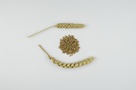
This designation refers to an intergeneric hybrid between wheat (Triticum) and wheatgrass (Agropyron). It belongs to a historically important group of experiments aimed at transferring useful traits from perennial wild grasses into cultivated wheat.
Agropyron glaucum was one of the wild grass species used in early Soviet wheat–wheatgrass hybridisation programmes.
A particularly important historical reference is the work of N. V. Tsitsin (Tzitzin), who reported in 1930 a successful cross between: Triticum vulgare var. lutescens 062 × Agropyron glaucum
Historical background
During the 1930s and 1940s, Soviet researchers, particularly in the USSR, investigated crosses between wheat and several Agropyron species.
The objectives included transferring:
-
Resistance to stem and leaf rust.
-
Powdery mildew resistance.
-
-
-
Perennial growth characteristics.
Accession
Numéro d'accession unique (MCPD 2):

Date acquisition (MCPD 12):
Nom de variété (MCPD):
Hybride Triticum Agropyrum No 1
Nom d'accession (MCPD 11):
HYBRIDE TRITICUM AGROPYRUM NO 1
Code variété (MCPD):
Nom commun français (MCPD):
Cropname (MCPD 10):
Nom latin (MCPD):
Triticum AESTIVUM LUTESCENS
Genre (MCPD 5):
Ssp (MCPD 8):
Type de reproduction (MCPD):
STATUT (MCPD):
Présence sur la liste positive PAN (MCPD):
Type de sélection (MCPD 19):
Remarque (MCPD):
Probably historical material from the 1930s–1950s
Origine et provenance
Pays d'origine (MCPD 13):
Soviet Union (1922 — 1991)
Instcode donateur (MCPD 22):
SUN000 - Soviet Union, Institut inconnu
Pays donateur (MCPD):
Soviet Union (1922 — 1991)
Provenance texte (MCPD):
DR.GALLAY EXP AGRICOLE MOSKAU
Sélectionneur ou maintenance (MCPD 18.1):
N. V. Tsitsin and collaborators (associated breeding programme)
ANCEST (MCPD 20):
PERRENIAL 34085(LUTESCENS 062/AGR.GLAUCUM//KOOPERATOR)//FR T.AUT.SUEDOIS
Autres numéros
BGRC (MCPD):
Multiplication et conservation
Duplicata de sécurité existe (MCPD):
Évaluation de la culture
Poids de mille grains (MCPD):
Description (blé)
Type de croissance (blé 4.1.1):
Densité de l' épi (blé):
Barbe (blé):
mutique (faible aristation jusqu'à 10 mm)
Couleur de la graine (blé):
Couleur de la glume (blé):
Évaluation de la culture (blé)
Epiaison (blé):
Index feuille (blé):
Index épis (blé):
Résistance céréales
Verse (blé):
Septoria nodorum plante (blé):
Septoria nodorum Epi (blé):
Résistance Rouille brune (blé):
Qualité boulangère (blé)
Protéine (blé):
Zéleny (blé):